Wednesday, November 19, 2014

Exploration 5: Empower

"We have more up here...shall we say...than filmmakers think and I think that they need to look at themselves in the mirror...and think like, okay, what if it was me being represented in this part " -participant, Code of Freaks

This image is from an article on Bullying Among Youth with Disabilities from the NCHPAD Blog

As I watched the videos, read transcripts, and the articles in the section, this statement kept returning to my thoughts. It was along a similar line of thinking that I began my own journey of self reflection many years ago. One of the most memorable books I read as an adolescent was Flowers for Algernon. Reading this book, about a intellectually handicap man who is given an experimental drug that temporarily reverses his condition, was an enlightening moment for me, both in how I viewed and interacted with people who were different from me. (For those of you who have not read the book, as Charlie becomes smarter-his intellectual handicap was pretty severe-he realizes that all of the people who he thought were his friends, were in fact making fun of him, laughing at him. This is the moment that still weighs on me to this day.) My educational career began in elementary and special education with an emphasis on the arts and a specialty in autism (ABA therapy). Since then life has moved me all around and my career has shifted (somewhat dramatically) and, while I have always remained in the arts, I am finally moving along a path leading back to my initial training.

When reflecting on how I have enabled, empowered, or made possible the inclusion of difference, I think of my oldest child. While she has no disability, she is extremely sensitive to the people she comes in contact with, how they are different from her, how they are similar, and the explanations behind these inquiries. Children are naturally curious about other people; however, they are not naturally inclined to discriminate against those who are different from them. This behavior is modeled by those in their life and the over-arching cultural to which they are exposed. Channeling her observations of difference into a belief that "we are empowered through difference"(Keifer-Boyd, Empower notes), enables her to be a vessel for change. When my husband and I parent her, I feel that we have a responsibility to provide a positive appropriate example for interacting with all people. In doing so, we do not merely discuss people who are different from our family, we seek out and interact with people who are different in a multitude of ways. Dr. Carrie Sandahl discusses how she is "building [a] disability culture" (The American with Disabilities Act and the Arts: A Celebration of Inclusion. [Or Unreasonable Accommodations]) in her work. We are seeking to build an inclusive culture within our family that celebrates differences in race, sexual orientation, disability, etc.,. In doing so, we are teaching our children that we are one body with many parts that are all important and have much to contribute on a local and global level. 

One of the ways in which we have enabled her is in the selection of her school. Her preschool program is heavily involved with the special needs program within the school (i.e. taking joint field trips, collaborating on projects together, etc). As a four year old she is "researching" and engaging in conversations with and about her friends with conditions such as hydrocephalus and cerebral palsy and who have different modes of transportation (i.e. walkers, wheel chairs). These constructive conversations are equipping her to openly and sincerely embrace those who are different from her. Two weekends ago, we were shopping and she encountered a lady in a wheel chair. With confidence, she walked up to the woman and struck up a conversation about her mode of transportation. For several minutes, the two discussed the wheel chair and its uses and why the lady needed it. Over the past few weeks, I have thought often of this encounter and wish I could have seen the situation from the perspective of the lady and/or my daughter. I am sure that this woman's experience shopping that day was not all pleasant and this inclusive. She wasn't not able to manipulate the wheel chair herself and relied upon her son to move her throughout the outdoor shopping area. In fact saw her several times as we shopped. However, I suspect that both parties shined a ray of sunshine into the lives of one another. Rather than turning to me to ask "what's wrong with her, mommy" my four-year old challenged the normal reaction to people who are physically different from her. Her reaction echoes Jon Novick's challenge in Don't Look Down on Me:

"I don’t want to tell anyone what to do or what to think or how to feel. But instead, what I’ll do is I’ll ask. I’ll ask that the next time you see someone who is different than you, think about what their day might be like. Think about all of the events of their life leading up to that point. Then think about their day, and think about what part of their day do you want to be."

My hope is that my child will always celebrate those around her for their inner and outer beauty (not perfection or normalcy). Just as Sandahl talks of disabilities as the real normal, we continue to question what is "normal" and what underlying cultural assumptions have crafted our existing belief system. 

Resources: 

2011 Illinois Arts Alliance presentation by Dr. Carrie Sandahl titled, The American with Disabilities Act and the Arts: A Celebration of Inclusion. [Or Unreasonable Accommodations]


Wednesday, November 5, 2014

Exploration 4: Diversity


As I ponder the meaning, depth, and fluidity of culturally relevant pedagogy, I cannot help but think of (current) trends in education, trends that almost completely remove the student as the axis of learning and seek to educate a homogenous group of children. Trends that “[add] some books about people of color, [have] a classroom Kwanzaa celebration, or [post] ‘diverse’ images [to make] one ‘culturally relevant’” (Ladson-Billings, 82). The “voyeuristic culture-vultures that consider [insert form of pop culture] to be the next trendy thing that can be used to hook students, only to draw them back into the same old hegemonic, hierarchical structures” (Ladson-Billings 82).

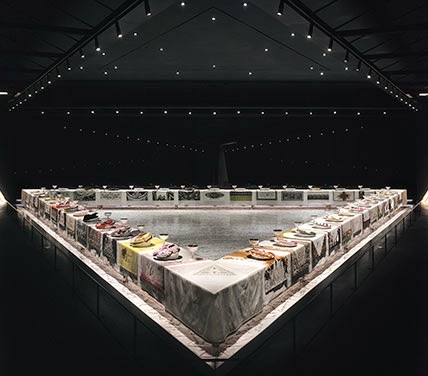
http://judychicago.arted.psu.edu/living-curricula/

In her introduction to TDPC, Judy Chicago discusses her reaction to an interpretation of The Dinner Party. “Although I knew the teacher had not intended to offend, this interpretation of The Dinner Party deeply disturbed me. While there is nothing wrong with doing autobiographies on plates, it is a mistake to claim that such a project has anything to do with The Dinner Party, which is about women’s achievements in history” (Chicago, from Introduction to TDPC).  Chicago’s statement addressing an instance in which her work was utilized for educational purposes but completely out of context echoes Ladson-Billings concerns over the meaning of “culturally relevant pedagogy” once it was introduced to “the marketplace of ideas”: misuse, misinterpretation and, even, a “distortion and corruption of the central ideas” (Ladson-Billings 2014, p. 82).

As educators, some of our best intentions can be misguided and overlook the value found in the diversity of our students. Sometimes we just miss the point.  One of the central ideas of culturally relevant pedagogy is viewing “students as subjects rather than objects” (Ladson-Billings, 77).  By repositioning the students as subject, they can be valued as “sources and resources of knowledge” (Ladson-Billings, 79) rather than mere recipients. This idea pushes students to engage with material that challenges their personal experiences and pre-conceived notions. By drawing from their own personal experiences, students make meaning that is relevant and valuable to them. In the study guide for Killing Us Softly 4, students are asked to use dialogue, collaborative projects, and journals to “think critically and independently about this material from a number of different perspectives, and to develop and defend their own point of view on the issues at stake.” Culturally relevant (sustaining) pedagogy also challenges the way we as educators view our students. Are we among those trying to fit our students into a formula? Do we have pre-conceived  notions of our own? Or are we exploring the individuality of our students, meeting them where they are and appreciating them for what they bring to the table?
Resources: 

Ladson-Billings, Gloria (2014). Culturally Relevant Pedagogy 2.0: a.k.a. the Remix. Harvard Educational Review, 84(1), 74-84.


Wednesday, October 22, 2014

Exploration #3: Difference


“[Ads] create an environment – an environment that we all swim in, as fish swim in water. And just as it’s difficult to be healthy in a toxic physical environment, if we’re breathing poisoned air for example, or drinking polluted water. So it’s difficult to be healthy in what I call a ‘toxic cultural environment’ – an environment that surrounds us with unhealthy images….”
- Jean Kilbourne, Killing Us Softly 4


“Difference” exists in many forms: gender, race, age, intellect, sexual orientation, socioeconomic status, religion, physical appearance, character traits, professions, cultures, and personal preferences. Each of these differences denotes a way in which we are like or not like another person. People use these differences to assess themselves and others, as well as determine what is valuable and desirable and what is not. Unfortunately, these ideas of difference are cultural constructions rather than natural progressions of the process of the examination of self and other (Jhally 2009). As in most cultures attempting to assign categories for understanding various groups within and without, these constructions assign an image of “normal” that both alienates and deprives those who do not fit within these categories.

One group that continues to struggle with stereotypes, gender assumptions and expectations and harmful attacks on body image is the female athlete. Female athletes are a commodity, both in their gender and their ability to perform and entertain. Female athletes are objectified and criticized based on unfair and unrealistic constructions of gender. Too thin, too tall, too heavy, too short, too fat, too bitchy, too masculine, too muscular, too butch. These criticisms reinforce one of the most common stereotypes of female athletes: lesbian. Our culture encourages us to be uncomfortable with anyone who cannot fit into the socially prescribed categories of male and female. The "natural" (or rather trained) response of female athletes is to conform to social norms of femininity by over-feminizing themselves. They have learned how to "send out the correct codes"(Jhally 2009) to be accepted.
Below are two sets of images depicting female athletes: the desirables and the un-desirables.


The Desirables. The first set is a collage of images of women whose bodies are physically fit, celebrated, powerful and sexualized. A yogi, a runner, an athletic supermodel, an athletic professional, a skier, a dancer, and a swimmer. Each exudes strength, agility, healthiness, flexibility, stamina, intensity, endurance, and excellence. They are also highly sexualized in their poses, glances and expressions toward the audience (Jhally 2009), and their attire that accentuates each woman's incredible physique. These are desirable, healthy, sexy women. Women that are strong and powerful. Together they exhibit an ideal female athlete by current cultural constructions: feminine, beautiful, but non-threatening. These women are images from current magazines.


These same women now have been overlayed onto an advertisement (that I manipulated) that depicts how culture has been taught to view them: meat, an object for consumption with a price tag to be bought and sold at the whim and fancy of the consumer, the viewer, the audience. Although the group is much more intimidating than the singular images would be, as individuals they reinforce cultural ideas about women as submissive and subordinate (Jhally 2009). Four of the women are looking directly at us. Two have hidden faces. One is in profile. The women looking at us do so with what Jhally and Goffmann identify as a "licensed withdrawal." Their eyes appear to be looking in our direction but they are not paying attention to the world in which they have been assigned or the viewer enjoying that world. The women who are not looking at us are allowing us to look without the commitment of engagement, but rather simply to admire what is before us. The placement of hands and poses of their bodies indicate vulnerability as they serve no utilitarian function and the poses are unnatural and (in some cases) distorted. Although these women are confident, competent women within their field, they are reduced to images to be dissected like cuts of meat.(in some cases) distorted. Although these women are confident, competent women within their field, they are reduced to images to be dissected like cuts of meat.


Lastly, these same athletic women are displayed with an array of fresh, organic produce, the "natural choice." While their poses, expressions, and engagement with the viewer does not change. What we interpret and associate with the image does. These women are healthy and athletic. Motivation and  choice have shaped their figures. The positive connotations of the background call to mind clean living and diets, in a time when it is popular, trendy, and (fortunately) possible to easily live health conscious lives.

The Un-Desirables. The second group is a lesser known group of female athletes. These women do not appear in popular magazines. Their beauty, physique, and femininity are not used to sell products. The poses in which they appear do not render them vulnerable or sexualized. They are the undesirables. U.S. Olympic weight lifter Sarah Robles (first woman) and Holley Mangold were the the strongest women in the America in 2012. Robles could barely afford to compete in the London Olympics due to lack of funds. Her physical appearance deterred organizations/companies from offering her sponsorships. Despite their overwhelming qualifications, the women below  were denied sponsorships, media coverage and equitable treatment due to their body types and the misconception that "thin = fit and healthy." 

The reading of this image is very different the first "meat" image. The athletes are still a commodity. Superimposed over the image of meat, these women are subjected to the harsh stereotypes assigned to large women, women are appear to be unfit, or women whose body type isn't "perfect." Regardless of the fact that all four of these women are world class athletes that compete on the Olympic level, they are objectified not for their beauty and femininity but for their lack of.  


Are these women our "natural choice"? They are real, unedited, nonconforming to the cultural expectations, healthy women. Motivated by ambition, love of the sport, positive choices, these women refuse to allow the perceived ideas of their bodies hinder or deter them from what they want. 


In the Codes of Gender, Sut Jhally states “there is nothing natural or biological about gender or gender identity.” Women, just like men, are "athletes." The term "female" should not be relevant in their ability to perform and excel. What does a "female athlete" look like? All of these women. All women. Thin, tall, heavy, short, large, small, muscular, short hair, long hair... Appearance does not determine ability and skill anymore than biology determines gender.

Kilbourne challenges “get involved in whatever moves [you] to change not just these ads but these attitudes that run so deep in our culture and that affect each one of us so deeply, whether we’re conscious of it or not. The changes have to be profound and global and they’ll depend upon an aware, active, and educated public—a public that thinks of itself primarily as citizens rather than primarily as consumers.”

Resources:
The Codes of Gender: Identity and Performance in Pop Culture 2009, 73 min. http://pennstate.kanopystreaming.com.ezaccess.libraries.psu.edu/node/41623

Dietrich, L. (2012, August 10). Criticism of Female Olympians' Bodies Harms Athletes. Retrieved October 20, 2014, from http://www.aauw.org/2012/08/10/criticism-of-female-olympians-bodies-harms-athletes/

Killing Us Softly 4: Advertising's Image of Women 2010, 46 min.
http://pennstate.kanopystreaming.com.ezaccess.libraries.psu.edu/node/41635
Michael Kimmel: On Gender 2008, 55 min. http://pennstate.kanopystreaming.com.ezaccess.libraries.psu.edu/node/41507

Saner, E. (2008, July 28). The gender trap. Retrieved October 20, 2014, from http://www.theguardian.com/sport/2008/jul/30/olympicgames2008.gender

Wednesday, October 1, 2014

Exploration #2: Cultural Artifacts

iPhone 6

In selecting my cultural artifact, I began with an object so ingrained in our everyday lives it seems to have become an extension of our very bodies.  The iPhone. What are some contemporary and personal meanings encoded in this object? A connection to everything needed throughout the day. For me, it is my husband, my school-aged child, my sister, my mother, my students, my calendar, the News, my interests, my momentary musings. This device is my repository of pictures, videos, contacts, data, budgets, most frequented online shopping spots, ideas, and music. It is my navigation system both physically and emotionally. The iPhone has become an extension of my person, my hand, my fingers. I turn to it during my leisure time, down time. It serves as a welcome distraction, an escape. I never leave home without it.

Smart phones, particularly the iPhone, represent connectivity. These devices break down the barriers of time and space, language and culture. iPhones speak a global language and open the lines of communication and exploration between groups that otherwise would remain isolated. While they come in a beautiful slick non-gendered package, each owner seeks to express herself by personalizing the exterior and interior with skins, protective cases, wallpapers, screens, apps and keyboards. 

iPhones are so embedded in our culture that imagining life without them is as foreign as looking to the Encyclopedia Britannica as the primary source of information on any given topic. Although, my personal investigations started with the iPhone, I chose an older, but related, artifact to continue my discussion.

This rotary phone is an old version with the "guts" removed for my children's use. 
The rotary phone. This image of an “antique” phone (as one of my high school students described it) represents a simplified idea of how a phone functions today. It marks a moment in the technological evolution of the telephone. It is neither the beginning nor the end, but rather somewhere in between. At the time of its popularity, this object was used to communicate, personally and professionally with people in close proximity, cross-continentally, or internationally.

The year 1919 marked the beginning of the rotary phone era. After WWII, Henry Dreyfuss created the shape in the image above that would dominate the visual form of the rotary form for most of its lifetime. Rotary phones (and phones in general) initially appeared only in the homes of the wealthy and installation of one into the home was a sign of status. As their popularity spread, cities and suburbs began to see phones in homes. Rural areas were often excluded due to a lack of infrastructure. In the beginning, phones all shared a similar appearance to the original black model. However, as phones became more accessible, the styles became more individualized. Such an example is the princess phone that was popular among women.

This is an image depicting a "French Phone" like the one my grandmother gave me as a teenager. This image is part of my personal experience with the rotary phone and part of my reason for selecting this image.  
Unfortunately, the 1960s mark the beginning of the end for rotary phones as they were slowly replaced by newer touch-tone technology (Roberts). However, these phones can still be found in homes of "hold outs" today (my grandparents included).

The subjects asked to respond to this image were forced to look back at their own memories or the memories of others in order to interpret the meaning of the object. I asked eleven people to respond to the images, 5 male and 6 female, ranging in age from 18 to 72 of mixed socioeconomic backgrounds, ethnicities, and sexual orientations. The responses gathered from this exercise illustrate how “meanings of objects are derived from a continuum of memories” (Boyd, Amburgy, and Knight, 2007 p 20) and support the idea that “memory is never objective and fixed; rather it is subjective and fluid” (Boyd, Amburgy, and Knight, 2007 p. 20). One respondent, a 29 year old Vietnamese woman, replied “I associate communication, advancement, connectedness, relationship and help with this image. I also associate a period of time with it that seems a little more simple and probably a little magical because we weren’t part of it.” She credited her “personal interaction with phones, history class, [her] background and classes in communication studies, museums, books and personal observation and reflection” as the sources for such a statement. Her “magical” experience was evoked by movies, readings about the periods in which this older technology was popular and a general since of “wonder and curiosity” for things of old. Several of those I asked recalled seeing these types of phones used as props in period piece movies and television shows. One women noted the sexuality found in a beautifully manicured hand dialing on a rotary phone from a popular television show. 

One older gentleman reflected on moments of “sitting and talking, devoting time to speaking with another…in kitchen nooks.” Another recalled it as his primary connection to his distant grandmother and noted the large amount of time spent in conversation with her on such a phone.The women in these memories are 1950s housewives, pictures of domesticity with the latest technology dangling from their ear. These memories evoke an image of white middle class American women gossiping away on their phones.
The sense of nostalgia and familiarity this object evokes is telling of both the primary user of the phone as well as the marketing of the telephone at this time to women in the home. Of course, the phone was transformative for businesses as it increased the numbers of persons that could be accessed on any given day. However, the most widely associated person (from an image search and those I showed the image to) is the housewife, mother, grandmother, a female figure. Memories from my own childhood include my mother talking on the phone "for hours." 

However, the domestic housewife was not (and is not) the only subject of these images. My search revealed working class women and even pin-ups talking on these phones. In her article "Shaping the American Women: Feminism and Advertising in the 1950s," Christina Catalona calls attention to a group of feminists that identify "the 1950s as the pinnacle of gender inequality"(Catalona 2002, 45) claiming that "mass media especially advertising in women's magazines, perpetuated the denigration of women" (Catalona 45). While women in this era are portrayed in a variety of other occupations, the primary usage for the phone image appears to be the home and the switchboard or secretarial position. However, in both, women are presented as prim and proper objects of beauty to be looked upon and appreciated for their aesthetics. 

A younger female noted the irony of this image as she confessed to feeling connected to this phone with a cord whose purpose was to remain stationary. She states “I felt more freedom when I used a phone like this than my fancy smart phone that remains with me wherever I go.” Pondering this image, she journeyed back to a “time when I used to run around the lawn in a t-shirt and no shoes playing in the mud and getting dirty. We didn’t watch TV or play video games. We played outside and hunted for lost treasure in the creek behind my parents’ house. We didn’t worry about what so and so said about us to hurt our feelings or whether they were our friend on facebook. We had each other that’s what mattered most.” Her connection to these images are not necessarily gendered but rather class related. Growing up in a poor rural area, these memories of a time gone by are ideals. They are memories shaped by what she knows today and what she thinks she remembers about yesterday. A time when she was too young recognize class divides. Or that the phone in her home was not the newest technology. 


A male subject, age 30, reminisced of using “one at my grandmother’s house as a child” and noted “the competence it takes to use one would probably be lost on current children.” Searching for current readings of this image and illustrations of the out-dated technology, I uncovered an interaction between children of varying ages, gender and ethnicities interacting with a rotary phone. What is revealed is both amusing and indicative of the culturally obsolete quality of the device as well as a dying telephone jargon. 


Another male also associated the image with his grandparents as “they were the only ones to have this still in their home and in use” even today. His response was that the technology was “outdated” just as grandparents are often considered “outdated members of society.” 

One respondent noted the “form signifies its function” or lack there of as he mused on the roles that phones play in our lives today. Phones today are our connections with the world. They are keep us connected with our friends, family, activities, and information. Phones allow us to know and understand the world around us on a global level. 

Just in case you did not already know, here is a "how to" for the telephone...not to be confused with a cellphone.... 


Resources: 

Catalano, Christina (2002) "Shaping the American Woman: Feminism and Advertising in the 1950s," Constructing the Past: Vol. 3: Iss. 1, Article 6.


Martin, D. (1994, January 10). Rotary Pay Phones Return, This Time to Foil Drug Deals. The New York Times. Retrieved from http://www.nytimes.com/1994/01/10/nyregion/rotary-pay-phones-return-this-time-to-foil-drug-deals.html


Roberts, William Lee. “Western Electric A look at the evolution of the Dial Telephone.” http://www.arctos.com/dial/


Rotary phones ring true for few. (n.d.). Sacramento Business Journal. Retrieved October 1, 2014, from http://www.bizjournals.com/sacramento/stories/2001/03/12/focus3.html


This Attention Deficit World: Frantic, Free, and Out of Control. (n.d.). Retrieved September 26, 2014, from http://www.enotalone.com/health/5651.html

Tuesday, September 2, 2014

Exploration 1: Identity Mapping

"Hi, my name is Martee. You know, like the guy." Yep, according to most people I know, I have a boy's name. Thanks, Mom and Dad.  

Privilege and Oppression. Which Social Identities are privileged by the oppression of others? What are forms of privilege and by oppression? Which social identities are the targets of oppression by unearned privileges granted others? What are forms of oppression experienced by the targets of oppression?

 
Exploring these questions seemed quite fluid as I speedily typed words into the wordle screen for the image seen above. For many years, I feel that I have been aware of such inequalities. However, the most stunning revelation came as I began to see my own “identities” staring back at me from the image produced: an educated middle-class white female (I did mention, I was a girl, right?) from a southern religious background. The truth is I like to exclude myself from this group of "oppressors" and I feel justified in doing so because I do not exploit any power or privilege I might possess. But is that enough? Can I deny parts of my identity that are undeniable? Forget them? Is that possible?

True identity can be neither delivered or denied nor stored as mere information...true identity is something known in one heart and recognized in another.
 -- John Berger, "Concerning Identity"

Below I have mapped out what I consider to be the most significant and influential parts of my identity: 

 Map Key: (I utilized color instead of the varying line model suggested)

Blue - parts of my identity that I had no control over, the environment into which I was born/raised (with the exception of English speaking, needing to be added to this category as well) - primary dimensions.

Pink - distinctive innate characteristics that are mine, a part of my DNA (I originally included English speaking solely in this group, however, after some thought, it overlaps with the blue) - primary dimensions.

Orange - identities that I have assumed based on personal choices, ideals, and convictions - secondary dimensions

Yellow - geographical places that I believe have deeply impacted my identity at the corresponding stages of my life (and beyond) - secondary dimensions. 

The idea of privilege. Coming from a lower/middle class farming family in a very rural part of Louisiana, I never felt particularly "privileged" growing up. I always "had" less than others; however, my parents valued education and instilled within each one of us the importance of working hard. To this day, I have always taken pride in that I was the first generation of my family to go to college and complete a degree (one that I am still paying for) within a field that I have great interest and passion, the Arts.

With that said, I do not recall feeling a wall of separation between myself and what I wanted to achieve. Being white was a privilege. Being educated offered privilege and a small degree of power. Being an educated white middle class in the South, I was afforded opportunities (privileges) that many of my African American counterparts were not. 

Oppression. If I was oppressed, it was because I was female (despite my name). My family had definitive gender expectations that extended into all aspects of life, right down to the "chores" we were assigned. My arm still bears a scar from a rusty barbed wire fence that reminds me of my early "rebellion" against these assigned roles. My attitude was simply to prove that I could do anything my brothers could do...thus the scar.

My identity. Parts were chosen for me. Others I have selected and shaped. Who I am today is different from the person I was yesterday and will be tomorrow. In looking back through the years, I am always a bit surprised at how much I have grown, shifted, changed. How different I look from my roots. A primary example for me is race politics. Although I grew up in the rural South, the race politics that exist stood out as injustices to me from my first awareness of them. However, as Weedon describes, I took a self-proclaimed "liberal, colour blind position which claimed to see no difference" (Weedon, p 2). This position seemed sufficient until 1) I had children and 2) I moved back to the South after a decade long hiatus.  At which point, I realized that this passive approach presupposes difference as unimportant rather than something to be celebrated. Differences are vital to the understanding, appreciating, accepting and nurturing of one another. Weir suggests "a model of identity not as sameness, but as an historical process of holding together; not through stasis but through transformation. ... [and] that a transformative identity politics must incorporate both relations of identification and recognition of relations of power: thus, transformative identity politics are politics of self-critique and self-transformation, and transformation of a 'we'" (Weir, 2008, p 112). Discovering that "we" has been my challenge over the past year. Searching for how to identify with a collective, rather than simply as an individual. To which "we" do I belong? How does that redefine my identity? Alter it? Add to it?

The courses I teach are completely online with little to no physical connections between my students and myself. We all exist in a virtual world of texts, emails, documents, voice over slides, and the occasional phone call (the most common link to the non-virtual world). With a name like "Martee," I am often mistaken for a male instructor. I find myself in a constant state of self-critique and self-transformation in order to shape the way that my students "see" me through our interactions in each of my courses. The reason I teach? So that hopefully my students will more successfully navigate these spaces than I currently do.

Resources: 

Weir, A. (2008). Global feminism and transformative identity politics. Hypatia, 23(4), 110-133.

Video: Concerning Identity (9:25 min.) A reading by John Berger.

Weedon, C. (2002). Key issues in postcolonial feminism: A Western perspective. Gender Forum: An International Journal for Gender Studies.

Wednesday, May 7, 2014

Exploration 6: Reciprocal-Reflexivity (Action Research Plan)

When I began this course, I had a hard time envisioning the role Action Research could play in my online teaching. In fact, I was simply approaching this course as a means to understand and implement new and innovative methodologies to inform, improve and expand upon my current practices (i.e. action research;). Looking for simple technologies or techniques to implement, I did not see my activities as "research" for change. Little did I realize, that this was exactly what was taking place. As Karen Keifer-Boyd articulates in Critique, Advocacy, and Dissemination: I've Got the Data and the Findings, Now What?, action research is "a conscious effort to change conditions...a form of intervention into the public pedagogy of objects, signs, ideas, and practices of our everyday world" (Keifer-Boyd, 2012, p. 198). 

As a teacher, I desire to ignite an interest for art and art history within my students similar to and even greater than the one I experience. I want my students to leave my course as museum goers, supporters of the arts, locally and globally, and mindful of past, present and future cultures and how they are represented through the arts. Ultimately, I want them to be comfortable and confident with their new and/or expanded knowledge in such a way that allows for them to think, speak, and interact critically with the art they encounter and, in some cases, create. For students to explore and develop a voice of their own is the underlying goal of the courses I teach. Until now, I have encouraged this through discussion post interaction. Throughout this course, I have been slowly implementing and interjecting new technologies for students to explore as tools for reflection and expansion upon what they are learning. Through voluntary student participation, I have been able to explore and examine the potential of these media to motivate online dialogue making visible the networked ripples and interconnections of conversations beyond blog posts and replies. 


For this final exploration, I offered an opportunity for students to reinforce the knowledge they have gained in Art History 253 (a survey of Renaissance to Modern Art introduces students to the major stylistic tendencies and shifts within Western art history) as well as explore how art is an agent for change in the world, the United States and their own personal experiences. Utilizing the Art for Change Webquest I created for A ED 811, I asked students to complete a series of activities (that included readings, explorations, videos, searches, and reflections) that examine the communicative power of art. As this assignment was voluntary (and offered as extra credit), participation was (surprisingly) low. However, even the sparse participation has been extremely beneficial in working through the effectiveness and clarity of the webquest, namely the flow of the quest and how students can post their contributions and interact with others in this space.  


Getting Started for several of the students was actually the hardest part. None of the students had participated in an Webquest prior to this assignment and without clear guidelines or expectations, several expressed frustration and confusion as to how to begin the quest. Students were first asked to read an article on Achieving Social Change Through Art and watch a video of Iranian female artist, Shirin Neshat. While doing so, they were to reflect on these questions: 

How does or can an artist use his or her position as an artist to start conversations, challenge thinking, and reverse stereotypes, injustice or discrimination

What qualities and characteristics does art have that make it an ideal conduit for change?

Do you see instances where artists go too far in their efforts to challenge perspectives? Or even the opposite, artists who are too conservative in their work?

Where do you see art utilized to bring about change like this in the US? Are there existing social issues in the US that call for this extreme activism? With these questions as your base, compare and contrast her work with that of  an artist working in the US today. 

These responses were documented in blog format, some posted directly to the Webquest blog, others emailed their responses to me. Here is a sampling of their reflections: 

One student reflected "artwork has a magnificent impact to political and social change in America and in other countries. An artist can use his/her position to ignite conversation and debate on specific topics through the development of a unique style and purpose in each creation. Political art is one of the most powerful forms of art due to its ability to express the issues or topics of the governmental realm of the country. An artist can depict objects or use arbitrary colors or develop emotional paintings in order to start conversation and challenge the daily thought process of an average citizen."

Another expressed that art "must have slight controversy to it or it will not bring about deep thought and emotion."

Another described Neshat's work as "capturing the raw emotion of the public, in particular women."

Common ideas that appeared in these posts include: audience, impact, subject matter (i.e. "villain and hero), standard for art, "ever changing ideas," challenging injustices, conversation starters, therapeutic, and advertising.

One student observed that "our culture is by far more conservative than other countries, possibly because of the freedom[s] we possess, which makes the need for rising to issues seem unimportant or unnecessary...[when] in fact, art that expresses the struggles and obstacles of the government are [in her opinion] the strongest and most appealing art...." 

As quoted in Keifer-Boyd's article, "Critical action research toward social justice advocacy emphasizes a 'commitment to social transformation, challenging power relations, showing solidarity, recognizing and using emotions, being the change you want to see, and building spaces for critical dialogue'" (Keifer-Boyd, 2012, p. 198). This initial exploration illustrates the beginning of this process for my students. They are beginning to pinpoint areas in which art can function as an agent of change, examine how it serves to function this way in their own experience, and start to dialogue (ideally) with one another about art's role in this capacity. With the reading and video as a prompt, students take a closer look at the role of political art in the US and abroad while comparing, contrasting and critiquing its effectiveness. 

Unfortunately, the blog forum on the Webquest was not conducive to student interaction. Therefore, students worked singularly and did not interact with one another. I am still exploring how to foster a more participatory culture within this space.

In the next step, Make Change Happen, students were asked to brainstorm and reflect upon social issues where immediate change is necessary. This activity allowed for students to brainstorm issues, select one of personal interest, and explore ways in which that issue is already being addressed in art, by activist groups, etc. Students discussed a variety of topics: politics, inequality, discrimination, rape, bullying, education, war, poverty, arranged marriages, human trafficking, homelessness, propaganda, hunger, respect, and stereotypes, just to name a few. Students could utilize any form to display their brainstorm and reflections. Here are a few examples: 

"DISCRIMINATION: an unjustifiable reason why someone is denied or allowed certain things;
based on gender, race, sexuality, or economic status, etc." 
"EDUCATION: a vital part of childhood, enabling children to mature into productive members of society. Unfortunately, it has become so far removed from its original intent, it has become something that does more harm than intended -- as it places more emphasis on teachers and school systems than the students it should be helping." 
"BULLIES: people who put down and make fun of others to cover up their own insecurities. Not OK in any setting."
The research unearthed by this step of the process indicated that students moved outside of the bounds of the webquest and its resources for their information. Students looked to social networking sites (Facebook), non-profit groups (American Civil Liberties Union and Students First), as well as popular artists such as Banksy. Students also made connections to artists working in other industries, such as fashion. 

The Next Step, students were asked to further reflect on their research using these questions:

What do you SEE?
What do you THINK?
What do you KNOW?
What do you FEEL? 

Students were then asked to create a piece of digital art that addressed the issue they selected and articulated their responses to these questions. They could utilize the internet for tools and websites useful in creating online/digital art and could display their work in any (but not limited to) of the following forms: slide show, video, single image, sound bytes, voice, text, etc. Asking students to translate the information that they had gathered into an art form of their own was both intimidating (for some) and challenging (as many are not self-described "artists"). As this project was optional, most skipped this end exploration. However, a few did give additional voice to their causes. 

Instead of creating her own piece, one student selected this image by Banksy to illustrate her "cause."
In reflecting upon my current methodologies and this project, I was struck by an observation Keifer-Boyd made of student participation with avatars in virtual environments: "Most students find that the chat discussion removes some of the obstacles found in face-to-face discussion, such as having too little time for all to speak, too little time to reflect prior to contributing before the topic changes, or being too self-conscious to speak out. Those who have found their voice privileged in physical encounters are often initially resistant to the dialogue in virtual text-based approaches" (2012, p. 200). Many of my students, as well as myself, are still learning to navigate the virtual classroom. Finding a comfortable space to speak out, participate, and engage is challenging in that it requires a desire to connect with those around us, confidence in what you have to contribute and the assurance that you are participating in a safe space. Online courses offer flexibility in schedule and the opportunity for students to complete course work in a fashion that best suits their lifestyle and schedules. Within this structure, it is easy for students to remain disconnected from one another.  Instead of being discouraged by the low participation, I am challenged to investigate more inclusive methods into my "research" that will motivate students to interact with one another and collectively develop their "voice" while at the same time "making visible inequitable power relations, dialogue, reflection, and collective production" in an effort to "[change] perspectives" (Keifer-Boyd, 2012, p.  198).  

Resources: 

Keifer-Boyd, K. ( 2012). Critique, advocacy and dissemination: I've got the data and the findings, now what? In S. Klein (Ed.), Action research: Plain and simple (pp. 197-215). New York City, NY: Palgrave.